There is a straight, traceable line from a hotel meeting in 1953 to a president who tells you inflation is defeated while your grocery bill says otherwise. This is that line.
Key Takeaways#
- In December 1953, tobacco companies hired Hill & Knowlton not to deny the cancer link, but to ensure it could never be definitively settled in the public mind — manufacturing doubt rather than lying, because doubt is harder to defeat and it scales
- A 1969 Brown & Williamson internal memo stated it plainly: “Doubt is our product, since it is the best means of competing with the body of fact that exists in the mind of the general public”
- The fossil fuel industry adopted the same framework in the late 1980s — sometimes using the same PR firms and contracted researchers — to manufacture uncertainty around climate science
- Russia’s Internet Research Agency, the systematic delegitimization of the press and scientific agencies, and Trump’s “don’t believe the crap you see” are all structurally identical to the tobacco strategy: make truth feel like a contested, partisan concept
- The doubt machine is an architecture, not a collection of bad actors; removing any individual, including the president, doesn’t dismantle the structure — the methods are documented, practiced, and funded independently of any one person
This didn’t happen by accident. It didn’t emerge from the chaos of social media or the internet age. It was designed, tested, refined, and handed off from one generation of operators to the next. Understanding how it was built is the only way to understand why it is so hard to dismantle.
The Tool Gets Built#
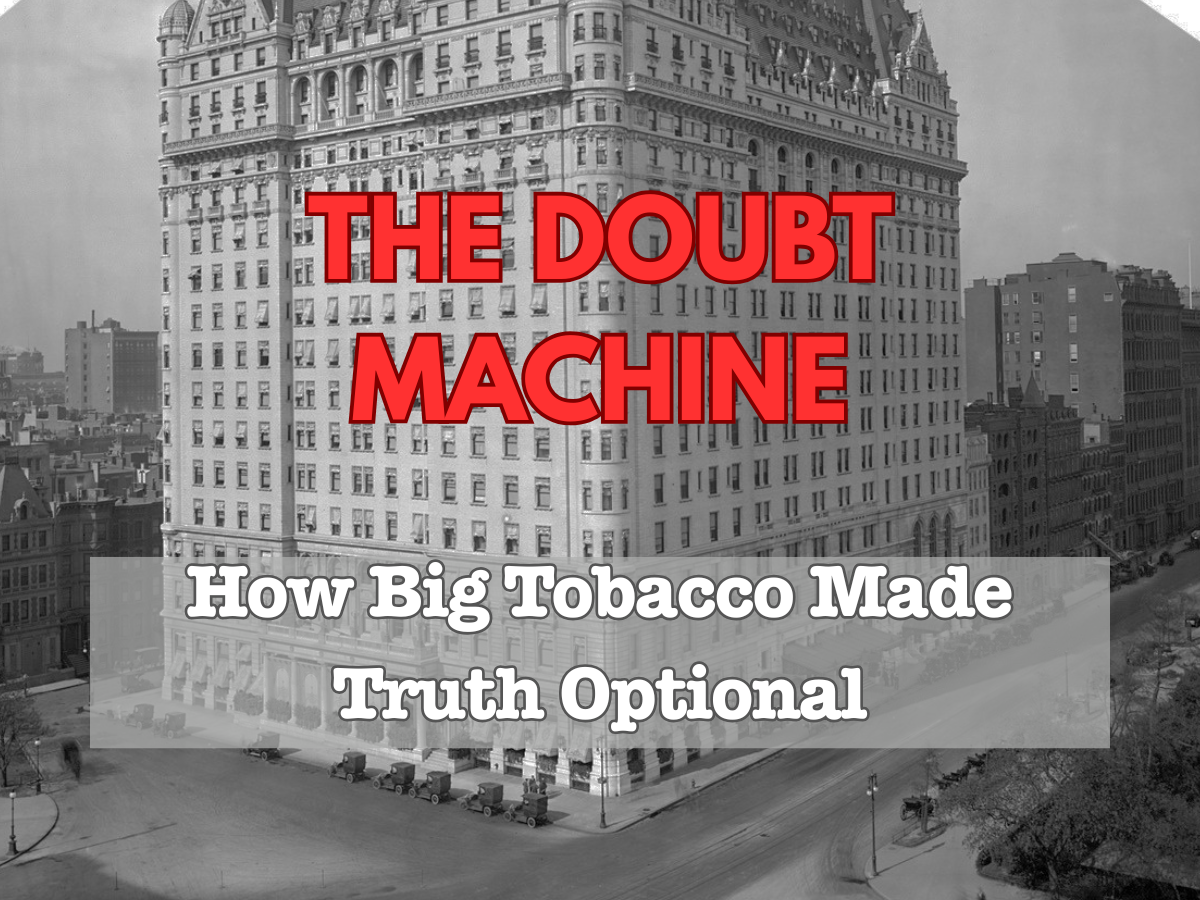
In December 1953, the presidents of America’s largest tobacco companies gathered at the Plaza Hotel in New York. They were not there to deny that cigarettes caused cancer. The science was already clear enough that several of them had quietly stopped smoking. They were there to ensure that the question could never be definitively settled in the public mind.
That is a different thing from lying. It is harder to defeat than lying. And it scales.
The man they hired was John W. Hill, founder of Hill & Knowlton. What Hill designed was the systematic manufacture of scientific uncertainty. Not denial. Permanent ambiguity. The strategy, captured in industry documents surfaced decades later through litigation, was explicit: create doubt about the health charge without actually denying it. Build a permanent “more research needed” fog around a question whose answer the industry already knew.
They created the Tobacco Industry Research Committee, a body whose name implied rigor and whose function was to undermine it. They built rapid-response systems to rebut new studies before they could land. They cultivated scientists willing to raise anomalous findings and broadcast those findings as if they represented mainstream scientific opinion. They placed articles in major publications through writers who did not disclose their industry ties. In early 1968, True Magazine published a piece by Stanley Frank arguing the cancer link remained genuinely unsettled. Frank had joined Hill & Knowlton months before publication. When he later rehashed the piece for the National Enquirer under a pseudonym, he was unambiguously on H&K’s payroll and did not disclose it.
An internal Brown & Williamson memo, not surfaced until decades later, stated the philosophy plainly: “Doubt is our product, since it is the best means of competing with the body of fact that exists in the mind of the general public.”
That is the foundational text of modern disinformation. Not a Russian intelligence document. Not a political strategy memo. Something written to sell cigarettes.
It worked for forty years.
The User Manual Already Existed#
Before Hill weaponized doubt, Edward Bernays had already proven that mass perception was something you could engineer rather than merely observe.
Bernays was Freud’s nephew, related on both sides of the family, a fact he never let anyone forget. He built a career applying his uncle’s theories about unconscious desire to commercial persuasion. He rebranded “propaganda” as “public relations” after World War I made the original word toxic. The core idea did not change. Human behavior could be shaped by appealing to emotion and identity rather than reason.
His early work for tobacco showed the method. In 1929, American Tobacco hired him to break the social taboo against women smoking in public. Bernays did not run ads. He staged an event. He arranged for women to light cigarettes during the Easter Sunday parade on Fifth Avenue, having framed it in advance to tipped-off journalists as a feminist act. The photographs ran nationwide. The story wrote itself because Bernays had written it.
What Bernays demonstrated was not just a technique. It was a proof of concept. The information environment people use to form beliefs is malleable. A sufficiently sophisticated operator can shape it without anyone noticing they have been shaped. Hill & Knowlton took that proof of concept and industrialized it for a specific purpose: protecting a product from the consequences of facts.
The fossil fuel industry adopted the same framework in the late 1980s and 1990s, in some cases using the same PR firms and the same contracted researchers. Philip Morris, facing pressure over secondhand smoke, created a front group called the Advancement of Sound Science Coalition. Its stated mission was defending scientific integrity. Its actual mission was building a cross-industry coalition covering tobacco, chemicals, food, and energy, all sharing an interest in manufacturing uncertainty around inconvenient science. The infrastructure of doubt had become a commercial service.
The Political Application#
The transition from corporate disinformation to political disinformation does not require a conceptual leap. It is a change of client, not of method.
Political movements looking to consolidate power did not need to invent new techniques. The doubt machine had already solved the hardest problem in propaganda: how to neutralize a factual consensus without appearing to lie. Flood the information environment with competing claims. Fund credible-looking countervailing sources. Exploit journalism’s instinct toward false balance. Make forming a confident opinion feel more costly than remaining uncertain.
Russia’s active measures doctrine, deployed at scale through operations like the Internet Research Agency, is structurally identical to what Hill & Knowlton built for tobacco. The goal in both cases is not to convince people of a specific alternative truth. The goal is to make truth itself feel like a contested, partisan concept.
But for understanding where America is in 2026, the Russian angle is actually a distraction. The more important story is domestic, institutional, and deliberate.
The GOP as Delivery System#
The Republican Party did not stumble into its current relationship with disinformation. It built the infrastructure, tested it, and by the time Donald Trump arrived, it was already running.
Decades of Fox News broadcasting an epistemically sealed alternative reality to tens of millions of viewers. The systematic delegitimization of institutions that verify facts: the press, scientific agencies, the nonpartisan civil service. The cultivation of a distrust identity, where believing mainstream sources became a marker of naivety, and doubting them became a marker of wisdom. Every one of these moves is structurally identical to what the tobacco industry did. Make the cost of trusting factual consensus higher than the cost of doubt.
Trump was not the architect of this system. He was its beneficiary and eventually its fullest expression. The system was built to protect a political payload. He was the payload.
What made it work at the institutional level was enforcement. Rep. Thomas Massie of Kentucky, who has frequently broken with Trump, put it plainly: “I think he’s attacking me to keep the rest of these guys in line. He’s trying to drive home to them that if you don’t stay in line, I’ll give you the Massie treatment.”
The threat is not abstract. Elon Musk warned Republican lawmakers in December 2024 that he was compiling a “naughty list” of members who buck Trump’s agenda, and pledged his PAC would play a significant role in primaries. Charlie Kirk warned that funding was being put together and that primaries would follow for any senator who voted against Pete Hegseth’s confirmation. The message to every Republican in a competitive seat was simple: independence costs you your career.
It worked. A group of House Republicans signed a letter vowing to oppose the Senate’s Medicaid cuts in Trump’s budget bill, warning they would vote no if the cuts were not changed. All of them voted for the bill. Senator Thom Tillis of North Carolina, one of the few remaining Republicans willing to occasionally break with Trump, announced he would not seek reelection after Trump threatened him with a primary challenge. In his farewell statement Tillis noted that “leaders who are willing to embrace bipartisanship, compromise, and demonstrate independent thinking are becoming an endangered species.”
In March 2026, Dan Crenshaw became the first member of Congress to lose renomination in the 2026 midterm cycle. He was the only GOP House member running for reelection in Texas without Trump’s endorsement.
This is not a party in disagreement about policy. It is a party under coercive discipline, where acknowledging inconvenient reality has been made professionally fatal.
What Gets Protected#
The purpose of all this infrastructure is not abstract. It protects specific claims from specific consequences.
In early 2026, Trump wrote in the Wall Street Journal that his tariffs had reduced the trade deficit. The Census Bureau reported the trade deficit had increased by nearly 37 percent in November, the most recent available month. Trump has claimed inflation was defeated. Most economists say inflation would be on target except for the tariffs, which are projected to cost the average American household between $1,300 and $1,500 in 2026, depending on the analysis.
Those are not matters of interpretation. They are numbers that exist.
And yet the claims circulate, land, and generate enough ambient uncertainty that a meaningful portion of the population does not know what is true. That is not a failure of the propaganda system. That is the system working.
In 2018, Trump told supporters at a Veterans of Foreign Wars convention directly: “Just stick with us, don’t believe the crap you see from these people, the fake news. Just remember, what you are seeing and what you are reading is not what’s happening.” That is not original political thinking. It is the tobacco memo restated for a political audience. Doubt is the product.
The current administration has extended this to the electoral system itself. It has made election denialism official federal policy, using investigative and enforcement powers to manufacture the appearance of fraud and flood the public with disinformation designed to erode confidence in the 2026 midterms. The agencies built to counter this, including CISA’s election security work, have been dismantled.
Who Is Responsible#
Responsibility distributes uncomfortably across many actors, and anyone reducing it to a single villain is either simplifying or selling something.
The tobacco industry built the proof of concept and paid to have it refined. Hill & Knowlton and the PR firms that followed bear professional accountability that was never seriously reckoned with. They continued operating, continued winning industry awards, and continued representing clients whose interests required the same basic service: making a bad thing look like a complicated thing. The fossil fuel industry licensed the method and funded its expansion into climate denial. Political consultants who imported these techniques into domestic politics did so with full knowledge of what they were building. Media organizations that normalized false balance provided the necessary distribution channel. The Republican Party, as an institution, made a decades-long choice to adopt this architecture as its operating system.
Trump is the most visible beneficiary of that architecture. He is not its author. Focusing exclusively on him mistakes the payload for the delivery system.
Bernays understood what he was demonstrating in 1929. Hill understood what he was building in 1953. The strategists who adapted these methods for political use understood what they were doing. None of this was accidental. None of it was inevitable.
The doubt machine was engineered, documented, paid for, and refined over decades by identifiable organizations making identifiable choices. It did not emerge from the chaos of the internet. It was built before most of the internet’s architects were born. The internet just gave it faster pipes.
What Comes Next#
There is no clean resolution here. Anyone offering one is selling something.
The doubt machine is an architecture, not a collection of individual bad actors. Removing any one person, including the current president, does not dismantle the structure. The methods are still documented. Still practiced. Still funded. Now amplified by social media systems that optimize for engagement over accuracy, and by AI systems that can generate credible-sounding countervailing content at scale, faster than any fact-checker can address it.
The tobacco industry’s strategy worked for forty years because the institutions capable of stopping it were themselves targets of the same technique. By the time the internal memos became public through litigation, millions of people had made decisions about their health in an information environment that had been deliberately degraded.
That is the cost of the doubt machine. It does not announce itself. It just makes truth feel exhausting, contested, and eventually optional.
We are living in that eventually.
Sources#
Bernays, E.L. (1928). Propaganda. Horace Liveright.
Proctor, R.N. (2011). Golden Holocaust: Origins of the Cigarette Catastrophe and the Case for Abolition. University of California Press.
Oreskes, N. & Conway, E.M. (2010). Merchants of Doubt. Bloomsbury Press.
Brandt, A.M. (2012). “Inventing Conflicts of Interest: A History of Tobacco Industry Tactics.” American Journal of Public Health, 102(1), 63-71.
Tye, L. (1998). The Father of Spin: Edward L. Bernays and the Birth of PR. Crown Publishers.
Brown & Williamson internal memo (1969), cited in Oreskes & Conway (2010) and Michaels, D. (2008). Doubt Is Their Product. Oxford University Press.
Allen, J. “Fear of Trump’s wrath ripples through House GOP.” CNN Politics, January 9, 2026.
Sullivan, P. “GOP senators terrified of crossing Trump, facing Musk-funded challengers.” The Hill, February 10, 2025.
Tillis, T. Statement on retirement from the U.S. Senate. June 29, 2025.
Talbot, H. “House Republican Dan Crenshaw unseated after Texas House primary vote.” NBC News, March 4, 2026.
Bogage, J. “Trump says inflation was ‘defeated.’ Some economists disagree.” CNBC, January 21, 2026.
Hibbard, L. “Trump claims his tariffs have ‘brought America back.’ Here are 3 things he got wrong.” Reason, February 2, 2026.
Protect Democracy. “Executive Override: How the Trump Administration Plans to Interfere with the 2026 Elections.” April 2026.
Greymantle Risk Advisory helps organizations understand the threat landscape, including the information threats that don’t show up in a SIEM. Reach out if you want to talk about what that looks like in practice.